Ready to Capture the Wild?
From expert-guided game drives to exclusive wilderness locations, every moment is designed for extraordinary wildlife encounters.

Spotted hyenas and African wild dogs are two of Africa’s most successful social predators. Compare their size, speed, strength, hunting strategies, pack behavior and what happens when they compete in the wild.

In Africa’s diverse landscapes, two fascinating carnivores often capture the attention of wildlife enthusiasts and researchers alike: the hyena and the African wild dog. Despite their superficial resemblance, these two species differ significantly in taxonomy, behavior, social structure, and conservation status.
This comprehensive guide aims to provide a detailed comparison between hyenas and African wild dogs, helping readers, from wildlife lovers and safari-goers to conservationists and business leaders interested in teamwork dynamics, understand their unique characteristics and ecological roles.
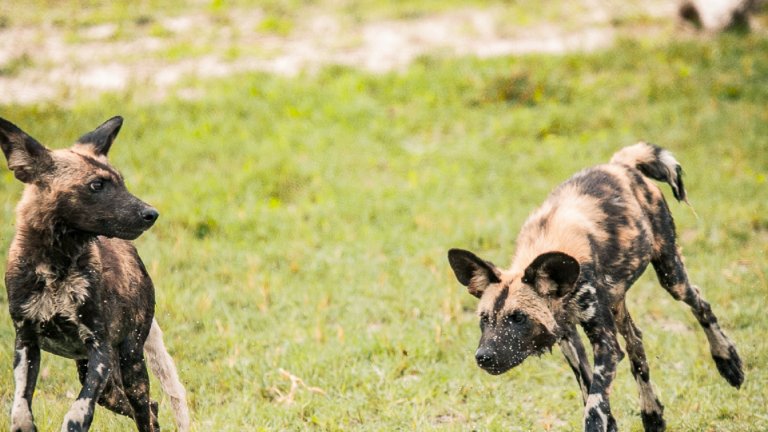
African wild dogs, often referred to as painted dogs or Cape hunting dogs, are among Africa’s most distinctive and endangered carnivores. Native to sub-Saharan Africa, these wild dogs are instantly recognizable by their slender build, long legs, and large, rounded ears, features that set them apart from other canines.

Their striking coats, patterned with patches of yellow, black, and white fur, not only provide camouflage in the wild but also make each individual uniquely identifiable.
As highly social animals, African wild dogs live and hunt in cohesive packs, relying on teamwork and communication to survive in the challenging African wild. Unfortunately, their populations have suffered dramatic declines due to habitat loss, human-wildlife conflict, and the spread of infectious diseases like canine distemper.
These threats have pushed African wild dogs to the brink, making them one of the continent’s most endangered species.
Conservation efforts are now more critical than ever to protect these remarkable animals and the ecosystems they help sustain.
Hyenas are a group of carnivorous mammals native primarily to Africa and parts of Asia, known for their distinctive appearance, powerful jaws, and complex social behavior.
Often misunderstood and sometimes unfairly characterized, hyenas play a vital role in their ecosystems as both skilled hunters and efficient scavengers. There are four species of hyenas, each with unique traits and adaptations that allow them to thrive in diverse habitats ranging from savannas to arid deserts.

Their social structures, particularly in spotted hyenas, are intricate and matriarchal, with dominant females leading large clans.
Despite their reputation, hyenas are intelligent and resourceful animals that contribute significantly to maintaining the balance of the natural world.
African wild dogs (Lycaon pictus), also known as painted dogs or Cape hunting dogs, are slender, social animals known for their cooperative hunting strategies and striking coat patterns. Hyenas, particularly the spotted hyena (Crocuta crocuta), are robust carnivores with powerful jaws and a reputation as both hunters and scavengers.
Hyenas and African wild dogs are different species with distinct evolutionary backgrounds. Hyenas are more closely related to the mongoose than to dogs. The population of African wild dogs has declined from about 500,000 to only around 6,600 individuals.
Spotted hyenas are currently listed as least concern on the IUCN Red List, but their numbers are declining due to habitat loss and human conflict.
While African wild dogs are endangered species facing severe threats such as habitat loss and human-wildlife conflict, spotted hyenas are classified as least concern but still face pressures from human conflict and environmental changes.

Hyenas belong to the family Hyaenidae and comprise four extant species:
Hyenas are sometimes mistaken for cats due to their grooming habits and certain feline-like physical traits, even though they are not closely related to cats.
The African wild dog (Lycaon pictus), sometimes called the African painted dog or Cape hunting dog, is a distinct species within the Canidae family. Unlike domestic dogs or wolves, it belongs to its own genus, Lycaon, characterized by unique dentition and specialized hunting adaptations.
| Species | Scientific Name | Family | Key Traits |
|---|---|---|---|
| Spotted Hyena | Crocuta crocuta | Hyaenidae | Large, social clans, bone crushers |
| Brown Hyena | Hyaena brunnea | Hyaenidae | Shaggy brown fur, scavenger |
| Striped Hyena | Hyaena hyaena | Hyaenidae | Striped coat, solitary |
| Aardwolf | Proteles cristata | Hyaenidae | Insectivore, termite specialist |
| African Wild Dog | Lycaon pictus | Canidae | Painted coat, cooperative hunter |
Spotted hyenas are robust carnivores with a powerful neck and large ears. They live in large clans led by a dominant female and exhibit complex social behavior.
Weighing up to 86 kg, they are larger and stronger than African wild dogs, with a sloping back due to longer front legs.
Brown hyenas have shaggy fur that helps them blend into arid environments in southern Africa. They are primarily scavengers with a more solitary lifestyle compared to spotted hyenas. Regional studies highlight their adaptability to harsh habitats.
Striped hyenas, with their distinctive striped fur and pointed ears, occupy a wider range including parts of the Middle East. They are more solitary and less aggressive than spotted hyenas, often scavenging alone or in small groups.
African wild dogs have a slender build with long legs and a narrow skull, adapted for endurance running. Their fur is short and bristly, with irregular patches of black, white, and yellow fur, and large, round ears that enhance hearing.
Hyenas have a robust build with a sloping back, a powerful neck, and broad shoulders. Their front legs are longer than their rear legs, giving a distinctive loping gait. Their fur varies from spotted to striped, with a short mane on the neck and shoulders in spotted hyenas.
One of the clearest physical distinctions is the relative length of their legs. African wild dogs have more balanced leg proportions, which aid speed and stamina, while hyenas’ longer front legs contribute to their powerful build but give them a hunched appearance.
African wild dogs’ coats are mottled with unique patterns for camouflage and individual identification, earning them the name “painted dogs.” Their large, round ears are crucial for communication and hearing. Their bushy tails often have a white or lighter-colored tip.
Spotted hyenas have sandy-colored coats with black spots, smaller and more pointed ears than wild dogs, and a bushy tail with a black tip. Their short mane raises when threatened, enhancing their intimidating look.
African wild dogs are highly social animals living in packs ranging from 10 to 40 individuals. These packs are cooperative units where all members care for pups and participate in hunting. The pack is typically led by a dominant breeding pair.
Hyenas live in clans with complex hierarchies dominated by a dominant female. Clans can number up to 80 members. While hyenas are social, they often exhibit fission-fusion dynamics, spending time alone or in small groups.
Wild dog packs have a clear alpha pair and cooperative leadership, emphasizing teamwork and mutual care. Hyena clans have a matriarchal system where dominant females lead and control resources.
African wild dogs are primarily diurnal hunters, relying on stamina and coordination to chase prey during the day. Spotted hyenas are more nocturnal or crepuscular, often scavenging or hunting under cover of darkness.
African wild dogs employ cooperative hunting tactics, chasing prey over long distances to exhaust them. They are known for their endurance and can run for miles to wear down and kill their prey. Their success rates are among the highest of African predators.
Hyenas are opportunistic hunters and scavengers. In fact, hyenas hunt for over 50% of their food, not just relying on scavenging. They can hunt alone or in groups and are known to kill and eat a wide variety of animals, as well as steal food from other predators, including wild dogs and lions.
African wild dogs inhabit open savannas, grasslands, and woodland areas across sub-Saharan Africa, with significant populations in southern Africa countries like Botswana, Tanzania, and Zimbabwe.
They are primarily found in open savannas, woodlands, and grasslands, and require large, connected habitats to support their wide-ranging movements.
Hyenas have a broader distribution, ranging throughout much of Africa, the Middle East, and parts of Asia. They prefer to live in wide-open plains, savannas, and grasslands, but also tend to stay in arid desert land as well as semi-mountainous terrain.
Hyenas are more adaptable to human-altered environments and can be found living in or near human settlements, including urban areas.
They are known for their ability to thrive in a wider range of environments compared to African wild dogs and are more resilient to human presence, whereas wild dogs require pristine habitats.
Hyena populations are most stable in large, protected parks, highlighting the importance of these areas for their conservation.
African wild dogs primarily prey on medium-sized ungulates such as impalas and gazelles. Their hunting strategy relies on endurance and teamwork to find food efficiently.
Hyenas have a more varied and generalized diet compared to African wild dogs, which primarily hunt large ungulates. Hyenas eat carrion, small to medium mammals, birds, reptiles, and occasionally fruits. Their powerful jaws enable them to crush bones and consume tough hides.
Hyenas and wild dogs often compete aggressively with other carnivores, including leopards, for kills in their shared ecosystem.
African wild dogs are endangered carnivores facing habitat loss, fragmentation, and human-wildlife conflict, including retaliatory killings by farmers protecting livestock. As their populations decline and survival strategies are increasingly tested, infectious diseases such as canine distemper, transmitted from domestic dogs, further threaten populations.
While spotted hyenas are listed as least concern, habitat loss, human conflict, and poaching affect their numbers. Human perceptions often lead to conflict and retaliatory killings.
Conservation efforts focus on habitat corridors, vaccination programs to control infectious diseases, and community-based education to reduce human-wildlife conflict.
Efforts include habitat preservation, conflict mitigation, and monitoring population trends to ensure sustainable coexistence.
African wild dogs play a vital role in the ecosystems of sub-Saharan Africa as highly efficient and successful hunters, and understanding their behavior, habitat, and field observation can deepen appreciation for their ecological importance.
Their packs, often led by a dominant female, work together to hunt antelopes, gazelles, and other animals, helping to regulate prey populations and maintain ecological balance.
This cooperative hunting strategy not only ensures enough food for the pack but also supports the health of the broader environment by preventing overgrazing and supporting biodiversity.
Despite their ecological importance, African wild dogs face significant challenges in the wild. Habitat destruction, retaliatory killings by humans, and the transmission of diseases from domestic dogs have all contributed to their decline.
As social animals, the loss of even a few individuals can disrupt pack dynamics and reduce their chances of survival. Today, African wild dogs are classified as an endangered species, with only a few thousand remaining in the wild.
Protecting their habitats, reducing human-wildlife conflict, and supporting ongoing conservation efforts are essential steps to ensure the future of this iconic African species.
Including side-by-side photos, range maps, and anatomical diagrams can greatly aid identification and understanding.
The cooperative hunting and social structure of African wild dogs offer valuable lessons in teamwork, leadership, and resilience applicable to business and organizational contexts.
Conversely, hyenas’ dominance hierarchies and adaptability provide insights into competitive strategies and resource management.
In summary, African wild dogs and hyenas represent two distinct species with unique roles in Africa’s ecosystems.
African wild dogs, with their slender build, large, round ears, and striking coats, are endangered carnivores whose survival depends on effective conservation efforts and on reducing human-wildlife conflict. Their cooperative nature and ecological significance make them a vital part of the African wild.
Hyenas, including the well-known spotted, striped, and brown hyenas, are robust predators known for their powerful jaws and adaptability. While some hyena species, such as the spotted hyena, are listed as least concern, others face their own conservation challenges.
The main differences between these two species are evident in their physical appearance: wild dogs with their painted coats and round ears, hyenas with their more muscular build and pointed ears—as well as in their behaviors and ecological roles.
Understanding these differences is crucial for appreciating the diversity of Africa’s wildlife and for supporting conservation efforts that protect both endangered species, such as the African wild dog, and other well-known species, such as hyenas.
By safeguarding their habitats and addressing the causes of human-wildlife conflict, we can help ensure that wild dogs and hyenas continue to thrive, maintaining the delicate balance of Africa’s ecosystems for generations to come.
The main difference lies in their taxonomy and behavior. Hyenas belong to the family Hyaenidae and are more closely related to mongooses, while African wild dogs are canines in the genus Lycaon. Hyenas are robust scavengers and hunters with powerful jaws, whereas African wild dogs are slender, cooperative hunters known for their endurance and pack cohesion.
Yes, African wild dogs are classified as an endangered species. Their populations have declined drastically due to habitat loss, human-wildlife conflict, infectious diseases such as canine distemper, and habitat fragmentation.
African wild dogs are primarily found in open savannas, grasslands, and woodland areas across sub-Saharan Africa, particularly in southern African countries such as Botswana, Tanzania, and Zimbabwe. Hyenas have a wider distribution, inhabiting much of Africa, the Middle East, and parts of Asia, and are more adaptable to various environments, including human-altered landscapes.
African wild dogs rely on cooperative hunting tactics, working as a pack to chase and exhaust their prey over long distances during the day. Hyenas are opportunistic hunters and scavengers; they can hunt alone or in groups and are known for stealing kills from other predators.
Both species are important carnivores that help regulate prey populations and maintain ecological balance. African wild dogs are highly efficient hunters that control herbivore numbers, while hyenas contribute as both hunters and scavengers, cleaning up carrion and competing with other predators.
Conservation efforts focus on protecting habitats, mitigating human-wildlife conflict, controlling infectious diseases, and promoting community awareness. For African wild dogs, establishing wildlife corridors and vaccination programs are crucial, while for hyenas, habitat preservation and coexistence strategies are key.
Yes, they often share habitats and compete for similar prey. Hyenas may steal kills from African wild dogs, and both species influence each other’s behavior and survival strategies in the wild.
African wild dogs have slender builds, large round ears, mottled coats with patches of yellow fur, and balanced leg proportions. Hyenas are more robust with powerful necks, longer front legs than rear legs, spotted or striped fur, pointed ears, and a sloping back.