Ready to Capture the Wild?
From expert-guided game drives to exclusive wilderness locations, every moment is designed for extraordinary wildlife encounters.

Discover the remarkable world of African wild dogs, one of Africa’s most endangered and successful predators. Learn about their pack structure, diet, hunting behavior, communication, habitat and survival in Botswana and across Africa.

African wild dogs, the largest wild canine in Africa, are native to sub-Saharan Africa. Also known as painted dogs, African spotted dogs, painted wolves, Cape hunting dogs, African hunting dogs, African painted dogs, and African painted dogs, these remarkable animals are among Africa’s most endangered predators.
African wild dogs have been listed as Endangered on the IUCN Red List since 1990. Their unique traits and behaviors make them a fascinating subject for wildlife enthusiasts and conservationists.
Here are the top 10 facts about African wild dogs, each supported by compelling numbers and statistics.
African wild dogs are classified as endangered, with an estimated population of around 6,600 individuals remaining in the wild.
This endangered population is small and continues to decline, highlighting the urgent need for conservation action. African wild dogs are primarily threatened by habitat fragmentation caused by human settlements and infrastructure development.

Conservation groups are working to create protected areas and wildlife corridors to reduce human-wildlife conflict and support the survival of these animals. Most of the remaining populations are found in Tanzania, Botswana, Zambia, Zimbabwe, South Africa, and Namibia.
African wild dogs are rare in North Africa and mostly absent in West Africa, with a potentially viable population in Senegal’s Niokolo-Koba National Park. The African wild dog has been exterminated in large parts of North and West Africa due to habitat fragmentation and human-wildlife conflict.
Their numbers continue to decline due to habitat fragmentation, human-wildlife conflict, and infectious diseases like canine distemper.
The African wild dog, known by many names including painted dog, Cape hunting dog, painted wolf, and painted hunting dog, holds a unique position in the animal kingdom. Scientifically classified as Lycaon pictus, this remarkable predator is a member of the Canid family, yet stands apart from other canid species such as domestic dogs, wolves, and foxes. Unlike its relatives, the African wild dog is the only extant species in the Lycaon genus, a testament to its distinct evolutionary path.
Originating in sub-Saharan Africa, African wild dogs have evolved over millions of years to thrive in diverse habitats, from open plains to sparse woodlands and even montane regions. Fossil evidence suggests that their lineage diverged from other canid species during the Pliocene epoch, around 2–3 million years ago.
This ancient heritage is reflected in their highly specialized adaptations: African wild dogs possess large, blade-like teeth and powerful jaws, perfectly suited to hunting and consuming a wide range of prey, from medium-sized antelopes to smaller mammals.

Genetically, African wild dogs are distinct from both domestic dogs and other wild canids.
Their unique genetic markers and specialized dentition set them apart, highlighting their adaptation to the challenges of the African wild. Interestingly, they share a distant common ancestor with the dhole and bush dog, but have since developed their own specialized niche as Africa’s most efficient pack hunters.
As keystone species, African wild dogs play a critical role in maintaining ecosystem health and balance. Their cooperative hunting strategies and complex social structures, often involving packs of 2 to 27 individuals, help regulate prey populations and support biodiversity across their traditional range in central and southern Africa.
Despite their ecological importance, African wild dogs face significant threats. Habitat fragmentation, human-wildlife conflict, and diseases transmitted from domestic dogs have led to a dramatic decline in wild dog populations, making them one of Africa’s most endangered species.
Conservation efforts, including the creation of protected areas and community-based programs, are vital to ensuring the survival of these extraordinary animals.
From their striking coat patterns to their sophisticated social lives, African wild dogs are a testament to the power of evolution and adaptation.
Understanding their taxonomy and evolutionary history not only deepens our appreciation for these painted wolves but also underscores the urgent need for continued conservation efforts across sub-Saharan Africa.
Wild dog packs typically range from 2 to 27 individuals, with an average size of about 10 to 15 members. African wild dog pups are cared for by the entire pack, demonstrating cooperative breeding where all members contribute to raising the young.
Packs consist of adults and yearling pups, and the alpha pair, often called the top dogs, are usually the only breeders, leading the pack’s social and hunting activities. Other pack members play crucial roles in supporting the alpha pair by feeding, guarding, and nurturing the pups, which strengthens pack cohesion.

African wild dog packs have a high male-to-female ratio, often with three times as many males as females, since females typically disperse to other packs to avoid inbreeding while males remain with their natal group.
The species’ complex social structure and strong bonds among pack members enable highly cooperative hunting and effective care of pups.
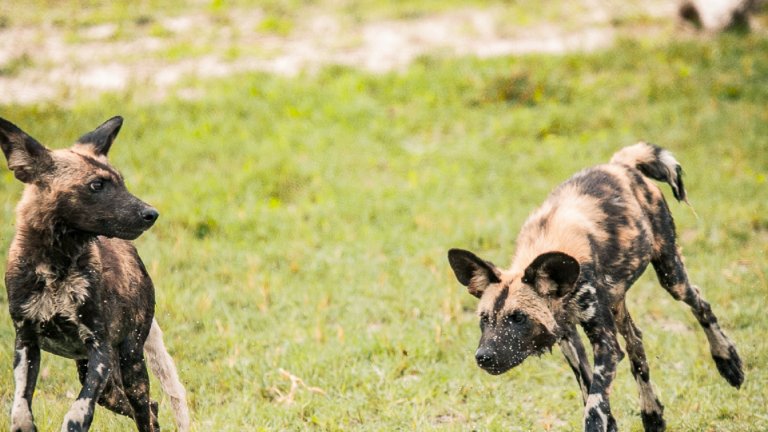
The multicolored coats of African wild dogs feature unique patterns of brown, black, white, and yellow patches, including distinctive white fur patches, much like a fingerprint.
Their long legs are an adaptation for endurance running, allowing them to sustain high speeds over long distances. African wild dogs also have large bat-like ears and a bushy tail with a white tip, which may help keep the pack together during hunts.
Another unique feature is their fused middle two toes, which distinguish them from other canids and aid identification. This allows researchers to identify and monitor individual dogs accurately in the wild.
African wild dogs hunt in highly coordinated packs, using teamwork and strategy to maximize their chances of success.
Dogs hunt by working together to outmaneuver and exhaust their prey, relying on precise communication and pack coordination.
Before launching a chase, they are known for approaching prey animals silently, using stealth to get as close as possible without being detected.
African wild dogs primarily hunt medium-sized antelopes such as impala, Thomson’s gazelle, and blue wildebeest, but they can also take down larger prey such as Cape buffalo or common eland, though these hunts are more challenging and require greater effort and coordination. As specialized hunters of terrestrial ungulates, African wild dogs typically hunt at dawn and dusk.
The average hunting success rate for African wild dogs is around 31.2%, with success rates varying significantly based on prey type, vegetation cover, and pack size. African wild dogs adjust their hunting strategy based on the prey species they target, demonstrating remarkable adaptability.
While their top speed reaches approximately 41 mph, African wild dogs excel as endurance runners, maintaining steady chases that can last from 10 minutes up to an hour, covering several kilometers to tire their prey.
The dominant female typically gives birth to 6 to 16 pups (average 10) after a gestation period of 69 to 73 days. Large litters are crucial for pack survival, as they help maintain stability and reproductive success.
African wild dogs are known for cooperative breeding, in which the entire pack helps guard, feed, and foster the young.
The dominant pair usually monopolizes breeding, while the rest of the pack helps raise the pups.
After hunts, adults regurgitate food for both pups and other adults in the pack, highlighting their social and cooperative feeding behavior.
Pups are weaned at about five weeks of age and begin to accompany adults on hunts at eight to ten weeks old. The entire pack cooperates in feeding and protecting the pups, who begin eating solid food at around three to four weeks old.
African wild dogs are highly skilled predators with a diet that mainly consists of medium-sized antelopes weighing between 15 and 60 kilograms.
Their most common prey include impala, kudu, and Thomson’s gazelle, which provide an optimal balance of size and nutritional value for the pack. These antelopes are well-suited to the wild dogs’ hunting strategy, which relies on endurance and teamwork to exhaust and capture prey.
In addition to antelopes, African wild dogs hunt smaller animals such as cane rats and hares, and occasionally birds or rodents, demonstrating their adaptability to varying prey availability across habitats.
This dietary flexibility helps them survive in diverse environments, from open savannas to sparse woodlands.
Their hunting tactics are tailored to the prey type; for example, they may rush at wildebeest to panic the herd and isolate a vulnerable individual or cut across the arc of territorial antelope species to prevent escape.
African wild dogs’ ability to adjust their diet and hunting strategies is a key factor in their success as predators in sub-Saharan Africa.
African wild dog packs maintain remarkably large territories, with home ranges often spanning between 200 and 2,000 square kilometers (approximately 77 to 772 square miles). These expansive territories are necessary to support the pack’s hunting needs and to provide sufficient prey resources.
Within these vast areas, packs scent-mark to establish boundaries and signal their presence to rival packs, reducing the likelihood of direct confrontations that could lead to injury or death. Despite the overlapping nature of some territories, African wild dogs generally avoid aggressive encounters with other packs, choosing instead to steer clear of rival groups.
The size of a pack’s territory can vary depending on factors such as prey density, habitat type, and competition with other predators like lions and hyenas. In regions with abundant prey, territories may be smaller, whereas in areas with scarce resources, packs must cover larger distances to meet their nutritional needs.
African wild dogs’ need for large home ranges makes them particularly vulnerable to habitat fragmentation caused by human development, which restricts their movement and access to prey, posing a significant threat to their survival.
Before setting out on a hunt, pack members engage in a unique “sneeze voting” system. African wild dogs have a unique social structure with strong bonds, and they communicate through various vocalizations and body language.
However, they lack the elaborate facial expressions and body language of wolves and rely more on other communication methods. If enough dominant dogs sneeze, usually three or more, the pack agrees to begin hunting, showcasing remarkable group decision-making.
Lions and other larger predators, such as hyenas, are the leading natural threats to African wild dogs, often killing them or stealing their kills (kleptoparasitism). However, the major threat to African wild dogs remains habitat loss, human persecution, and diseases transmitted from domestic dogs.
Viral diseases, including rabies and canine distemper, pose a significant risk to wild dog populations and can devastate entire packs.
The threats African wild dogs face include natural predators like lions, hyenas, and even eagles, as well as human-related issues such as habitat fragmentation and infectious diseases.
African wild dogs are found on open plains and in sparse woodlands in sub-Saharan Africa.
These top 10 facts highlight the extraordinary adaptations and challenges faced by African wild dogs. Understanding these numbers underscores the importance of continued conservation efforts to protect these unique and endangered mammals.
African wild dogs are also called painted dogs, painted wolves, Cape hunting dogs, African hunting dogs, and African painted dogs.
They primarily live in sub-Saharan Africa, with populations concentrated in southern and eastern Africa, including countries such as Tanzania, Botswana, Zambia, Zimbabwe, South Africa, and Namibia. They inhabit open plains and sparse woodlands and require large territories to support their hunting needs.
African wild dogs are classified as endangered by the IUCN Red List, with an estimated population of around 6,600 individuals remaining in the wild. Their numbers are declining due to habitat fragmentation, human-wildlife conflict, and diseases.
They hunt cooperatively in packs, using stamina and teamwork to exhaust prey. They primarily hunt medium-sized antelopes and adjust their hunting strategies depending on the prey species. They are endurance runners capable of chasing prey for up to an hour.
African wild dogs live in packs averaging 10 to 15 members, with a dominant alpha pair that typically monopolizes breeding. The entire pack cooperates in raising pups, hunting, and protecting one another, with strong social bonds and unique communication methods, such as “sneeze voting” before hunts.
Besides natural predators like lions and hyenas, African wild dogs face major threats from habitat loss, human persecution, and infectious diseases such as canine distemper and rabies transmitted from domestic dogs.
Conservation efforts focus on creating protected areas, establishing wildlife corridors to reduce human-wildlife conflict, preventing disease, and implementing community-based programs to promote coexistence with humans, helping to stabilize and increase wild dog populations.