Ready to Capture the Wild?
From expert-guided game drives to exclusive wilderness locations, every moment is designed for extraordinary wildlife encounters.

Three zebra species, rapid speed, group dynamics, and the role of zebras in savanna ecosystems and what protects them today.
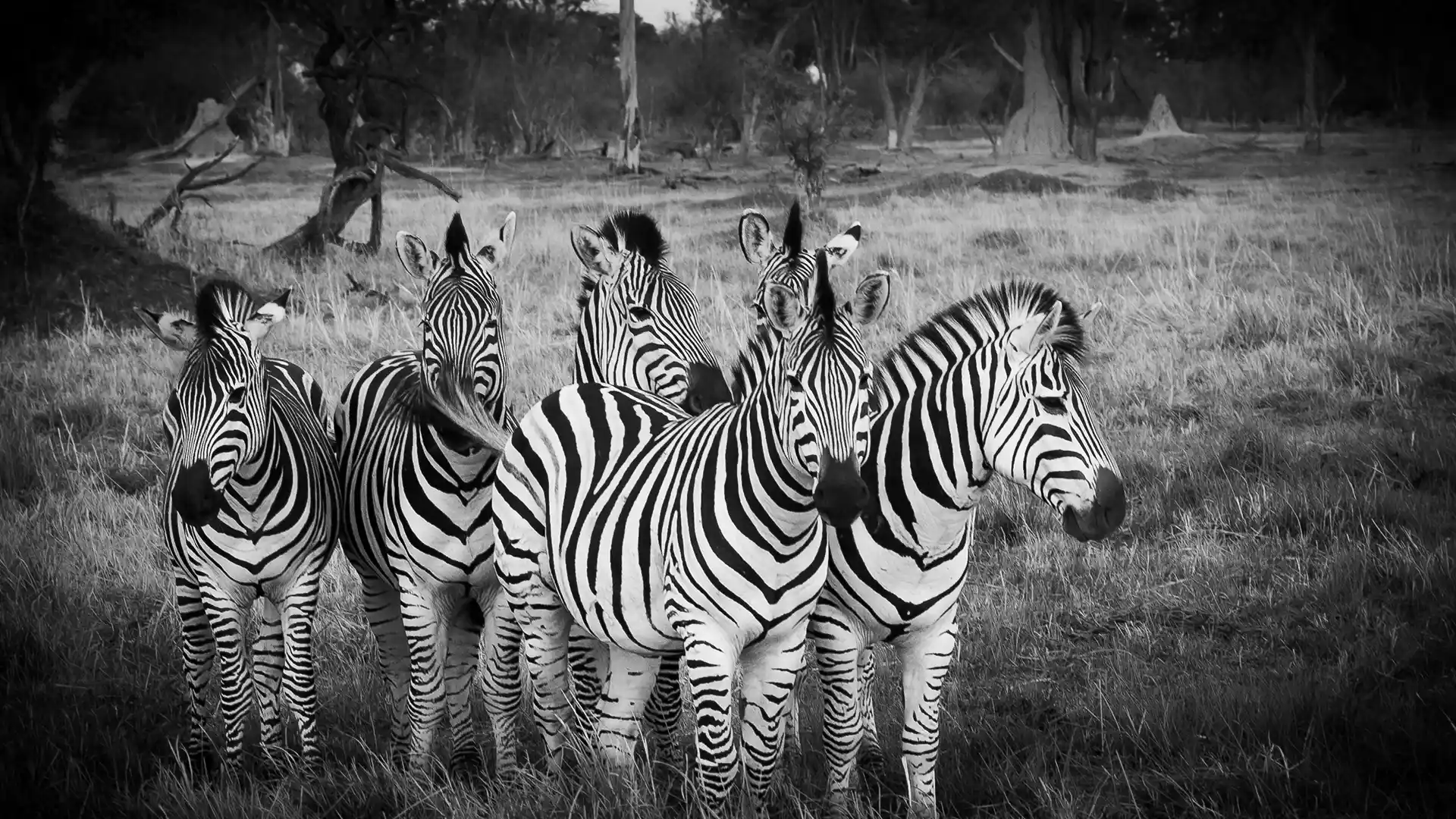
Zebras are wild African equids whose black and white stripes, complex social behavior, and ecological importance make them among the most studied and admired animals on the continent. They inhabit savannas, grasslands, and mountainous terrain from Ethiopia to South Africa, and they continue to fascinate researchers and wildlife photographers alike.
Few animals stop you mid-stride on an African plain the way a zebra does. Standing in shifting morning light, its black and white coat cuts a line so precise against the golden grass that the eye locks on instinctively. Yet beyond that unmistakable pattern lies a far deeper story-one of adaptation, social intelligence, and a survival struggle that intensifies with every passing decade.
A zebra is a wild member of the horse family (genus Equus), native exclusively to Africa and instantly recognizable by its bold striped coat. Though often called a “striped wild horse,” the zebra is a distinct lineage-closely related to domestic horses and donkeys, yet never truly domesticated. All three species belong to the family Equidae, sharing common ancestry with horses but differing sharply in temperament, social structure, and evolutionary history.
Here are the core zebra facts worth carrying into the field:
| Trait | Range |
|---|---|
| Shoulder height | 1.1–1.5 m (3.6–5 ft) |
| Weight | ~250–450 kg depending on species |
| Lifespan (wild) | 20–25 years |
| Diet | Primarily grass; occasional browse |
| Primary predators | Lions, spotted hyenas, wild dogs, crocodiles |
Zebras are herbivores that graze mostly on grass across savannas, grasslands, and open woodlands. Many populations migrate long distances in search of fresh pasture and water, tracking seasonal rains across landscapes that can shift from lush green to dust-dry within weeks. They are not simply grazing machines, however. Zebras are intelligent, sentient animals capable of forming strong social bonds, expressing recognizable emotions-fear, contentment, stress-and navigating complex group dynamics. That social intelligence is part of what makes them so compelling to observe and photograph in the wild.
Scientists recognize three species of zebra alive today, each adapted to distinct habitats across the African continent.
The plains zebra (Equus quagga) is the most widespread and numerous. Its range stretches across eastern and southern Africa, from South Sudan and Ethiopia south through Kenya, Tanzania, Zambia, Zimbabwe, and into northern South Africa. Bold vertical stripes mark the body, shifting to more horizontal patterns on the rump. Population estimates sit between 150,000 and 250,000 individuals, though the trend is declining.
The mountain zebra (Equus zebra) is a smaller, more compact animal built for rugged terrain. Two subspecies exist-the Cape mountain zebra and Hartmann’s mountain zebra-found in mountainous areas of Namibia and south africa. A distinctive grid-like pattern marks the rump, and a dewlap (a fold of skin under the throat) sets this species apart visually from its relatives. Total population sits around 35,000 across both subspecies.
Grévy’s zebra (Equus grevyi) is the largest zebra species, standing up to 1.5 m at the shoulder and weighing as much as 450 kg. It has a narrow head, large rounded ears, and very thin, closely spaced stripes with a white belly left largely unstriped. Its range is now limited to northern Kenya and small pockets of Ethiopia. With fewer than 3,100 individuals remaining, it is classified as endangered.
The extinct quagga-a plains zebra subspecies once found in south africa-was hunted to extinction by the late 19th century, a stark reminder of how quickly human pressure can erase a lineage.
Stand close enough to a resting zebra and the details accumulate quickly. The barrel-chested torso supports a long neck topped by an erect, bristly mane that runs from poll to withers. The elongated head narrows to large nostrils, and eyes sit high on the skull-placed laterally to provide a wide panoramic field of view across open grass.
Their long legs appear almost deceptively slender-thin legs that belie real power. Each limb ends in a single hard hoof, adapted for running across firm ground and delivering forceful kicks when the animal is cornered. Mountain zebras carry harder, more pointed hooves suited to rocky, uneven terrain.
Size and build vary meaningfully among the three species. Grévy’s zebra has a more donkey-like build-taller, leaner, with proportionally larger ears. Mountain zebras are slightly stockier, heavier through the shoulder. Plains zebras fall between, built for endurance across flat savannas.
Sensory adaptations matter in the field. Large, mobile ears rotate independently, detecting sound from multiple directions and signaling mood to nearby animals. A strong sense of smell helps individual zebras recognize group members and detect predators or water at distance. Unlike domestic horses, zebras typically carry chestnut callosities only on the forelegs, and their overall build reflects a grazing lifestyle shaped across millennia on open African landscapes.

The zebra’s black and white stripes are among the most debated features in evolutionary biology. The underlying skin is dark, meaning the coat is essentially dark with lighter striping layered on top-not the reverse. Foals are usually born with brownish or reddish stripes that darken to true black stripes as they mature.
Each zebra’s stripe pattern is unique-functioning like a fingerprint. Researchers can identify individual zebras from photographs using these patterns, a technique now enhanced by deep-learning algorithms applied to citizen-science photo datasets.
Stripe patterns differ across zebra species. Plains zebras carry broader, more widely spaced stripes with some southern populations showing faint “shadow stripes” between the bold bands. Mountain zebras display a grid-like rump arrangement with vertical stripes on the body. Grévy’s zebras wear fine pinstripes-the narrowest of any species-paired with white coats on the belly left largely unstriped.
The question of why stripes evolved has generated multiple hypotheses. A landmark comparative study published in Nature Communications found the strongest correlation between striping intensity and biting-fly pressure, with little support for predator camouflage or social signaling as primary drivers. A 2026 optical-modeling study on arXiv further demonstrated how stripe spacing generates disruptive spatial frequencies in the compound eyes of horse flies and tsetse flies, interfering with landing behavior at close range. Meanwhile, a UCLA study found that populations in warmer, wetter climates tend to have bolder, more intense white stripes covering more of the body-suggesting thermoregulation may play a secondary role. The emerging consensus: zebra stripes likely evolved under multiple selective pressures, with insect deterrence being the dominant force.
Rare color variations-partially striped individuals, unusually dark animals-have been documented in East Africa, though published data on their frequency remain limited.
The three different species span a meaningful size range:
| Species | Weight | Shoulder Height |
|---|---|---|
| Plains zebra | 220–385 kg | 1.1–1.4 m |
| Mountain zebra | 240–372 kg | 1.16–1.5 m |
| Grévy’s zebra | 350–450 kg | 1.2–1.5 m |
In a burst, zebras can reach speeds of approximately 60–65 km/h-fast enough to challenge a vehicle driving through a savanna reserve. That raw pace helps them outrun lions and spotted hyenas in short chases, though survival often depends less on top speed than on agility: sudden directional changes, sharp cuts, and powerful kicks delivered mid-stride.
Their musculoskeletal structure supports this performance. Long tendons act as elastic springs, storing and releasing energy with each stride. Efficient lungs fuel sustained effort across open plains and hills. The result is an animal built not just for explosive acceleration but for endurance-daily treks of many kilometers, and seasonal migrations that can span hundreds of kilometers.
In the Serengeti–Mara ecosystem, plains zebra herds participate in some of the world’s great wildlife spectacles, moving with wildebeest and other grazers to find food and reliable water sources as the rains shift across the landscape.
A typical zebra day unfolds around grazing. Long hours spent working through grass dominate daylight, interspersed with rest periods during midday heat, social grooming, and heightened vigilance at dawn and dusk-the hours when predators are most active.
Zebras can sleep standing up, and this is not a casual trick. A specialized “stay apparatus” in their legs-a system of interlocking tendons, ligaments, and joints-allows them to lock their limbs and relax muscles without collapsing. This mechanism, shared with horses, enables light rest while maintaining readiness to bolt at the first sign of danger. It is a defining anti-predator adaptation for an animal that lives in open habitats with limited cover.
However, deep, restorative sleep-including REM phases-requires lying down. Most zebras accomplish this in the relative safety of the group’s center, while other members remain standing and alert. The arrangement is deliberate: sentinels watch while vulnerable sleepers recover.
Young foals lie down more often and for longer periods than adults, building strength and coordination during their first weeks under the collective protection of the herd. In areas with heavy lion presence, zebras tend to rest in shorter bursts and choose open ground with good sightlines over denser vegetation.
A group of zebras is sometimes called a “dazzle”-a fitting name when dozens of striped bodies overlap in motion. Within that visual complexity lies a structured social order.
Plains and mountain zebras typically live in family groups centered on one dominant stallion, several mares, and their foals. These smaller family groups are remarkably stable: mares often remain with the same stallion for years, and strong social bonds between females create a cohesive unit. When conditions allow, these units aggregate into larger herds-sometimes thousands strong-during migrations or at shared watering points, where zebras gather alongside wildebeest and other grazers.
Grévy’s zebra social life follows a different logic. Males defend fixed territories near water or quality grazing, and females move through these territories with their young, forming loosely associated herds that shift in composition from day to day. The bonds between adults are less permanent, the social network more fluid. According to National Geographic, Grévy’s foals may be loosely watched by nearby adult mares while mothers feed, but the tight harem structure seen in plains zebras is largely absent.
Group living confers clear advantages: early predator detection, coordinated flight, shared vigilance, and collective protection of the young. As adolescent males mature, they leave their birth group to form temporary bachelor bands-loose coalitions where young stallions fight, spar, and develop the social skills they will need to eventually claim a territory or hold a harem of their own.

Zebras communicate using a layered system of vocal sounds, facial expressions, ear positions, tail movements, body posture, and direct physical contact. The repertoire is richer than casual observation might suggest.
Plains zebras use several distinct calls. A sharp, barking contact call keeps the group connected across distance. When feeling threatened, they produce a distinctive two syllable call-a short, urgent alarm that spreads rapidly through the herd. Softer snorts and whinnies signal contentment or mild irritation. The two syllable alarm sound is recognizable enough that experienced field guides can read the urgency before the predator comes into view.
Ear position is one of the most reliable visual signals. Ears pricked forward indicate curiosity or alertness. Ears flattened back communicate aggression or fear. A half-back position suggests uncertainty. Combined with head carriage, tail swishing, and body tension, these signals create a continuous, readable stream of information between animals.
Social grooming-where one zebra gently nibbles another’s neck or shoulders-strengthens bonds among family members and helps reduce stress within the group. Two zebras standing parallel, heads to tails, each grooming the other’s withers, is one of the most quietly compelling moments to witness in the field.
Species differences exist. Grévy’s zebras produce deep, grunting calls that sound more like a cross between a hippopotamus and a donkey than a typical horse whinny. These vocalizations carry well across the arid, open habitats where the species lives.
Zebras are herbivores whose diet consists primarily of grass. During the dry season, when grass becomes scarce, some species supplement with leaves, bark, and coarse browse-whatever the landscape offers. But grass remains the foundation.
Plains zebras function as “pioneer grazers” within savanna ecosystems. They eat tougher, lower-quality grasses that antelopes and wildebeest avoid, using their sharp front teeth to clip stems close to the ground. Broad molars then grind the fibrous material down. Their teeth grow continuously to compensate for the heavy wear this diet demands. By trimming tall, coarse vegetation, zebras create fresher regrowth for other grazers that follow-wildebeest, gazelles, and smaller antelope species that prefer shorter, more nutritious grass.
Water access is non-negotiable for most zebras. Plains zebras typically drink at least every one to two days, shaping their movement patterns around reliable water sources. Grévy’s zebras tolerate slightly drier conditions, capable of walking long distances between permanent water points to find food and sustain themselves.
The ecological importance of zebras in savanna systems is substantial. They control grass height, recycle nutrients through dung, create pathways through dense vegetation, and serve as primary prey for large carnivores such as lions and spotted hyenas. Remove zebras from these ecosystems, and cascading effects ripple through both plant and predator communities across the world’s most iconic grasslands.
Breeding in zebras follows a broadly seasonal pattern, though timing varies by species and region. In plains and mountain zebras, mares typically mate only with the stallion of their family group-a dominant male who has earned and defended access to several females over months or years.
Gestation runs approximately 12 to 13 months. Zebras typically produce a single foal; twins are extremely rare and seldom survive in the wild. Birth itself is often swift and quiet, occurring within the safety of the group.
Early development is astonishingly fast:
This pace is not optional-it is a survival imperative in habitats where predators may detect a birth from the scent alone.
During the first hours, mother and foal bond intensely. The foal memorizes its mother’s unique pattern of stripes, learning to pick her out from a crowd of similar-looking adults by sight and smell. This visual imprinting is remarkably precise. Weaning occurs at roughly 9–10 months, with sexual maturity reached at around 2–3 years for females, slightly later for males depending on species and social opportunity.
Other herd members-especially mares-often help shield foals during predator encounters. In Grévy’s zebra populations, young may be left in loose “kindergarten” groups watched by nearby adults while mothers graze at distance, a strategy suited to the species’ more open social structure.
Adult zebras face a formidable roster of predators. Lions represent the greatest threat to fully grown animals. Spotted hyenas, especially in coordinated packs, take adults and juveniles alike. Crocodiles ambush zebras at river crossings-some of the most tense moments in any migration. African wild dogs, leopards, and cheetahs occasionally prey on foals.
The first line of defense is not speed-it is vigilance. Group members take turns watching while others graze. Alarm calls spread rapidly through herds, and at the first signal, the group often bunches together, creating a wall of overlapping stripes that can confuse an attacking predator’s depth perception and targeting ability.
When flight begins, zebras are agile and unpredictable-sharp directional changes, sudden stops, bursts of acceleration. Cornered or overtaken, they fight with powerful backward kicks from hind legs that can reach above their backs, capable of breaking a predator’s jaw or ribs. Biting adds another layer of defense.
Foals and weaker individuals are positioned toward the center of the group during movement and at waterholes-natural chokepoints where danger concentrates. The collective geometry of a moving herd, with experienced mares and the stallion on the perimeter, creates a protective structure that has been refined across millions of years of co-evolution with African predators.
Plains zebras are the most abundant and familiar of any zebra species, ranging from southern Ethiopia and South Sudan through the great grasslands of Kenya, Tanzania, Zambia, and Zimbabwe into northern south africa. They are the zebras most wildlife photographers encounter first, and often the ones that keep drawing them back.
Their striping varies regionally-a detail worth noting for anyone photographing across multiple sites. Northern populations in warmer, wetter habitats carry bolder, more heavily contrasting stripes covering more of the body. Southern populations sometimes display fewer body stripes, lighter legs, and faint shadow stripes between the main bands. Animals from the same species can look strikingly different depending on geography.
Plains zebras are highly social and migratory. In ecosystems like the Serengeti–Mara, large groups numbering in the thousands move across the plains in seasonal waves, tracking rainfall to reach greener feeding grounds and reliable water. These migrations are among the most visually powerful events in African wildlife.
Major threats include continuing hunting for meat and skins, habitat loss as savannas convert to farmland, and competition with livestock for grass and water. Though currently classified as near threatened rather than endangered, recent local declines in zebra populations across parts of their range suggest that without careful management of hunting, land use, and migration corridors, their status could deteriorate within decades.
Grévy’s zebra, classified scientifically as equus grevyi, is both the largest and most endangered of the three species. Today it survives primarily in the arid and semi-arid grasslands of northern Kenya, with small, isolated pockets in Ethiopia.
The species takes its name from French president Jules Grévy, who received a zebra from East Africa as a diplomatic gift in the 1880s. The animal’s striking appearance-narrow pinstripes, oversized ears, tall frame-made an impression that endures in the species name.
The population trajectory is alarming. In the 1970s, an estimated 15,000 Grévy’s zebras roamed East Africa. Today, approximately 2,812 remain in Kenya and roughly 230 in Ethiopia-an 80% decline driven by habitat loss, competition with pastoral livestock, hunting, and prolonged drought.
Behaviorally, Grévy’s zebras diverge from their plains relatives. Males defend fixed territories rather than maintaining harems. Mares and foals move between territories, and social bonds among adults remain comparatively loose. This flexibility suits their arid habitats, where resources shift unpredictably and animals must roam widely between water sources.
Conservation efforts center on community-based conservancies in northern Kenya. Organizations like the Grévy’s Zebra Trust work directly with local herders to reduce conflict, secure grazing corridors, provide supplementary water, and monitor populations through events like the Great Grevy’s Rally-a citizen-science census that uses photographic identification to track individual zebras across vast landscapes.
The relationship between zebras and humans has never been simple. Historically, commercial hunting for hides, sport hunting, and culling by ranchers who viewed zebras as competition for pasture all took heavy tolls. The quagga’s extinction in the late 19th century stands as the most permanent consequence of that pressure.
Modern threats are less dramatic but equally corrosive. Expanding agriculture, fencing, roads, and settlements fragment the habitats zebras depend on, severing access to seasonal feeding grounds and water. For migratory plains zebras and wide-ranging Grévy’s zebras, a fence across a traditional corridor can be as lethal as a bullet-slower, but just as final.
Competition with livestock compounds the problem. Cattle, sheep, and goats overgraze key grasslands, degrading the very pastures zebras need. In some regions, this sparks direct conflict with pastoral communities who see zebras as competitors for resources their own animals require.
Disease transmission from livestock-including certain equine infections like anthrax and babesiosis-adds biological pressure. Droughts intensified by climate change reduce water and forage simultaneously, stressing zebra populations already squeezed into smaller, degraded areas.
In some tourist zones, overly intrusive safari practices-vehicles crowding too close, operators forcing unnatural proximity for photographs-can cause chronic stress in zebra groups without contributing meaningfully to conservation. The distinction between ethical wildlife observation and exploitation matters, and it starts with how operators position themselves relative to the animals.
The current conservation landscape for zebras demands sustained, coordinated action. Grévy’s zebra is listed as endangered by the IUCN. Mountain zebra holds a vulnerable classification. Plains zebra sits at near threatened-a designation that can shift quickly if pressures intensify.
National parks and wildlife reserves across Kenya, Tanzania, Namibia, and south africa form the backbone of zebra protection, safeguarding core populations and critical migratory routes from development. But parks alone are not enough. Zebras move beyond boundaries, and their survival depends on what happens in the spaces between protected areas.
Community-based conservation models have proven effective. Programs where local people share in tourism revenue, receive grazing rights or alternative livelihoods, and participate in anti-poaching patrols align zebra protection with human well-being. When communities benefit directly from living wildlife, the incentive to protect zebras becomes self-reinforcing.
International and local organizations support zebra conservation through habitat restoration, GPS collar tracking, genetic monitoring (particularly important for Cape mountain zebra populations at risk of hybridization), and targeted action plans for the most threatened populations.
For those who want to contribute directly, the path is straightforward:
Zebras have appeared in African rock art, folklore, and proverbs for centuries. In many traditions, the zebra symbolizes the balance of opposites-black and white, order and wildness, beauty and resilience. These are not superficial associations; they reflect a deep cultural awareness of an animal that has shared landscapes with humans since the earliest days of our species.
In modern contexts, the plains zebra serves as the national animal of Botswana, appearing on coats of arms, postage stamps, and wildlife logos across the continent. The animal’s image carries immediate recognition worldwide-an ambassador for African wildlife whether on a conservation poster or a photographer’s portfolio.
Zebras have a long history in captivity, from Roman arenas and 18th-century European royal menageries to today’s zoos. Public fascination remains high, but welfare challenges are real. These are wide-ranging, social animals accustomed to open habitats and daily movement; confining them to small enclosures raises legitimate concerns about chronic stress, stereotypic behaviors, and diminished quality of life.
Attempts to domesticate zebras for riding or draft work have largely failed. Compared with selectively bred horses, zebras maintain a stronger flight response, a more unpredictable temperament, and a pronounced tendency to bite or kick-traits that served them well across millennia of evolution alongside lions but make them poor candidates for the stable. They are not a wild horse awaiting taming; they are a fundamentally different animal shaped by different pressures.
The distinction matters in captivity contexts as well. Exploitative displays that treat zebras as entertainment props serve neither the animals nor conservation. Scientifically managed breeding programs linked to habitat restoration and field research represent a different category entirely-one that can contribute meaningfully to the survival of threatened populations.
Photographing zebras offers a unique challenge and reward for wildlife enthusiasts and professionals alike. Their striking black and white stripes create a natural contrast that can produce visually stunning images, but capturing their essence requires understanding both their behavior and environment.
Early morning and late afternoon provide the soft, golden light that enhances the zebra’s stripes and adds depth to photos. In Botswana, the Makgadikgadi Pans region is renowned for spectacular zebra migrations, where vast herds move across the salt flats and surrounding grasslands in search of fresh grazing and water.
This annual migration, one of Africa’s largest, typically occurs during the rainy season when zebras follow the receding floodwaters to new pastures. Other notable locations include the Serengeti and Maasai Mara for plains zebras, Samburu for Grévy’s zebras, and
Namibia’s rugged landscapes for mountain zebras. These natural habitats offer dynamic backgrounds that complement the zebra’s patterns.
Focus on composition by capturing groups, or “dazzles,” to showcase the mesmerizing effect of overlapping stripes. Close-up portraits highlight individual stripe patterns and facial expressions, revealing personality and social bonds. Using a telephoto lens allows for respectful distance, minimizing disturbance while capturing candid moments.
The high contrast of black and white stripes can confuse camera autofocus systems, so manual focusing or using focus points on the eyes is advisable. Avoid harsh midday sun that can create unflattering shadows and reduce stripe definition. Patience is key observing zebra behavior helps anticipate moments of interaction, movement, or rest that make compelling images.
Respecting zebra space is crucial. Maintain a safe distance to avoid stressing the animals or disrupting their natural behavior. Support conservation-minded tour operators who prioritize animal welfare. Remember, the goal is to capture beauty without compromising the well-being of these iconic creatures.
With the right approach, photographing zebras can be a deeply rewarding experience, offering a window into their complex social lives and the breathtaking landscapes they inhabit.
Below are answers to common questions that extend beyond the main article, written for clarity and practical understanding.
Embryological studies show that zebras develop on a dark base coat, with lighter striping forming on top. The skin beneath the fur is predominantly dark across the body, reinforcing the interpretation that zebras are effectively black animals with white stripes rather than the reverse. Visually, the pattern appears as roughly equal bands of black and white, which is why the question persists-but the developmental evidence points consistently in one direction. This dark-skin foundation also helps explain why some individuals in certain populations display reduced or faded striping while retaining dark underlying pigmentation.
Individual zebras have been tamed-historical accounts include zebras pulling carts in early 20th-century Europe-but the species has never been truly domesticated through generations of selective breeding the way horses have. Zebras retain strong defensive instincts, a pronounced flight response, and unpredictable behavior that makes them genuinely dangerous in close quarters. Keeping a zebra as a pet is illegal or tightly regulated in most jurisdictions, requires specialized veterinary care and large enclosures, and raises serious animal-welfare concerns. For these reasons, private ownership is not recommended and is generally considered incompatible with the animal’s needs.
No. Large-scale seasonal migrations are primarily a feature of certain plains zebra populations-most famously in the Serengeti–Mara ecosystem and Botswana’s Makgadikgadi region, where herds follow rainfall to reach greener pasture. Mountain and Grévy’s zebras tend to move more locally, tracking patchy rainfall and shifting grazing conditions across their home ranges rather than following a fixed, large-scale migratory loop. Even among plains zebras, not all populations migrate; some occupy territories with year-round resources and remain relatively sedentary.
Zebras evolved specifically within African ecosystems, shaped by the continent’s predators, grasslands, and climate patterns over millions of years. They have never naturally established wild populations on other continents. While zebras appear in zoos, wildlife parks, and occasionally fenced reserves outside Africa, these are managed populations, not self-sustaining wild ones. The species’ ecological requirements-vast open habitats, specific forage, social structures adapted to African predator communities-make natural establishment elsewhere extremely unlikely.
During severe dry periods, zebras may migrate long distances to find remaining water and graze on tougher, less palatable plants that other grazers avoid. Grévy’s zebras can go several days without drinking, though reproduction and foal survival decline sharply during prolonged drought. When droughts intensify die-offs can be significant, and competition with livestock for dwindling resources often increases. Drought resilience varies by species and population, but no zebra is immune to the effects of extended water and forage scarcity.