Ready to Capture the Wild?
From expert-guided game drives to exclusive wilderness locations, every moment is designed for extraordinary wildlife encounters.

Wondering what it's actually like to stay in a mobile safari camp in Botswana? Here's what to expect from the tents, bathrooms, meals, camp team, evenings and life in the wilderness.

Mobile safari camps offer a unique way to experience an African safari, combining adventure with comfort in some of the continent’s most wildlife-rich areas. Unlike permanent lodges, these camps move with the wildlife, allowing exploration of multiple locations and landscapes on one journey. This style provides an authentic safari experience, immersing you in the sights and sounds of the African bush.
Wake up in a spacious canvas tent with essential comforts, surrounded by Botswana’s Okavango Delta or Moremi Game Reserve. Each day brings new wildlife viewing opportunities, from African wild dogs and their complex pack behaviour to elephants in Chobe National Park. The camp crew handles logistics, setting up tents with en suite bathrooms and preparing meals, so you can focus on the adventure.
Whether you’re a seasoned traveler or a first-timer, a mobile safari camp blends luxury and wilderness immersion. It balances comfort with the thrill of exploring wildlife-rich areas, making it ideal for those wanting to experience Africa in its purest form.
Start planning your unforgettable mobile safari journey today with a dedicated camp crew by your side.

A mobile safari camp is a temporary tented camp established in or near Botswana’s wildlife areas as part of an overland safari.
Unlike other safari tours, a mobile camping safari is a guided adventure that sees you move between temporary camps set up in remote wilderness areas. These experiences are carefully choreographed, with camps positioned in private or low-density areas.
You might spend several nights exploring Moremi Game Reserve, move to Khwai, and then continue north towards Savuti.
The camp provides your accommodation and base while you’re exploring each area.
But there’s an important distinction:
Mobile camping doesn’t automatically mean roughing it.
On a fully serviced mobile safari, you aren’t carrying a tent on your back, cooking over a tiny camping stove or digging a hole every time nature calls.
A professional safari team manages the camp while you spend your time exploring Botswana, and companies like ours specialize in mobile safaris that move between wilderness areas.
So what is it actually like?

Your tent becomes your bedroom in the wilderness.
Mobile safari tents are designed to provide considerably more space and comfort than the small tents associated with recreational camping.
At Wild For Game Safaris, guests stay in spacious safari tents with proper sleeping arrangements and private en-suite bathroom facilities, on luxury mobile safaris, tents can be setup to have en-suite bathrooms (Camping Style)😁 .
You have somewhere comfortable to sleep, change, organize your belongings and retreat to during the heat of the day.
But don’t expect a permanent hotel room disguised as a tent.
That’s not really the point.
A mobile safari camp keeps you physically connected to the environment around you.
Canvas separates you from the sounds of the bush rather than concrete walls.
At night, you hear Botswana.
And sometimes Botswana is surprisingly noisy.
Yes.
A fully serviced mobile camping safari is very different from sleeping on a thin camping mat.
Comfortable beds and bedding allow you to get a proper night’s sleep after spending hours exploring the bush.
That’s more important than it sounds.
Safari days often start early.
You might be awake before sunrise, spend several hours on a morning game drive, return for breakfast or brunch, rest during the middle of the day and then head out again during the afternoon, which gives keen photographers time to apply dedicated wildlife photography tips tailored to Botswana.
A comfortable bed stops the word camping from becoming something you begin to fear by day four.
This is usually one of the first questions guests ask.
And quite reasonably.
Bathroom facilities vary considerably between safari operators and different styles of mobile camping.
On Wild For Game Safaris’ mobile safaris, our tents include private en-suite bathroom facilities, rather than more rustic setups such as a bush bathroom used on some simpler mobile camps, and you can see what’s typically included in these safaris before you book.
That gives guests privacy while retaining the mobile nature of the camp.
You should always check bathroom arrangements before booking any mobile safari because “camping safari” can describe everything from very basic participation camping to fully serviced mobile tented accommodation.
They are not the same product.
Yes, you can shower in the bush.
Mobile camps use systems designed to operate without the permanent plumbing you’d find in a lodge; some operators use bucket showers, while better-equipped camps still let you shower comfortably in the bush.
Water is a valuable resource in wilderness environments, so the experience also encourages sensible use.
There is something rather wonderful about washing off the dust from a long game drive while listening to birds and wildlife outside.
It’s not a marble hotel bathroom.
But that’s exactly why people remember it.
The safari team does.
On a fully serviced mobile safari, guests aren’t expected to dismantle tents, load the camp and rebuild everything at the next destination.
The support team manages the practical work required to operate the camp.
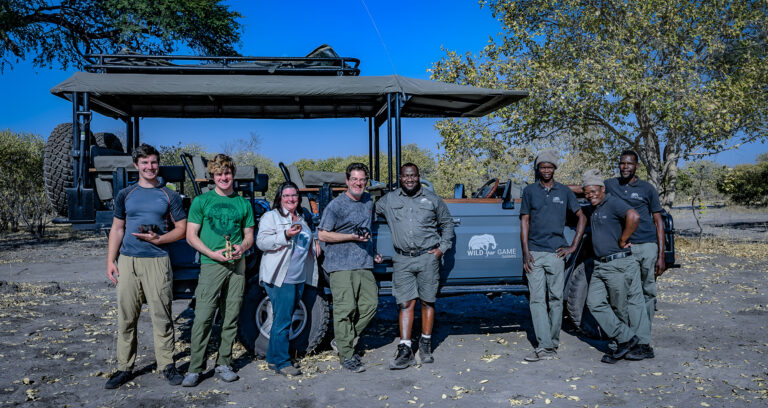
At Wild For Game Safaris, the safari team can include your professional guide, chef and camp assistants.
While you’re concentrating on wildlife and photography, the team concentrates on making camp work.
This distinction is worth understanding when comparing safari prices.
A low-cost participation camping safari and a fully serviced mobile safari may both contain the word mobile, but the guest experience can be very different.
You may be surprised by what can come out of a bush kitchen.
Meals are prepared in camp by the safari team rather than guests having to cook for themselves.
A safari day is normally structured around wildlife activity, so meals fit around the game-drive schedule.
You may start with coffee or tea and something light before heading out in the morning, and if you’re curious about how our days usually run, our Wild For Game Safaris FAQ explains the broader safari schedule.
After the morning drive, you return to camp for a more substantial meal.
Later in the day, refreshments precede the afternoon drive before dinner is served back at camp in the evening.
The exact routine changes with the season, itinerary and day’s wildlife activity.
If the lions decide to do something interesting at precisely the time you were supposed to return for breakfast, breakfast can wait a little.
That’s safari.
Mobile camps normally have a communal area where guests can eat, relax and spend time between activities.
Meals become part of the safari rather than something separate from it.
There’s no restaurant to rush into and out of.
You’re still in the wilderness.
Breakfast conversations tend to involve whatever happened that morning, especially for guests on a dedicated photo safari focused on Botswana’s wildlife and landscapes.
Dinner conversations often begin with what happened that afternoon.
And eventually someone starts showing everyone the photograph they are particularly pleased with.
Evenings are one of the best parts.
After the afternoon game drive, you return to camp as darkness settles over the bush.
Dinner follows, often with time around the campfire.
The pace changes.
During a game drive, you’re constantly looking, listening and anticipating.
At camp, you can sit still.
You talk about the day’s sightings.
You look through photographs.
You learn more from your guide.
And you listen.
A hyena calling in the distance sounds very different when you’re hearing it from a tented camp rather than through a television.
So does a lion.
A mobile safari camp operates differently from a permanent lodge connected to substantial electrical infrastructure.
That’s particularly relevant for photographers.
Camera batteries don’t care that you’ve traveled into the wilderness.
They still want electricity.
Wild For Game Safaris’ safari vehicles provide charging facilities, allowing guests to keep essential camera equipment and devices charged during the journey.
If photography is important to you, we recommend bringing multiple camera batteries rather than relying on a single battery.
The same applies to memory cards.
Botswana has a nasty habit of producing more photographs than you expected.
A mobile safari is not designed around permanent connectivity.
Depending on where you are, mobile coverage may be weak or unavailable.
For some travelers, that initially sounds inconvenient.
Then they spend a few days without constant notifications and discover that perhaps civilization can survive without them for an afternoon.
If reliable internet access is essential for work or another reason, discuss connectivity with us before your safari.
But generally, think of a mobile safari as an opportunity to be more connected to where you are and less connected to everywhere else.
On longer safaris, laundry becomes more important because baggage space can be limited.
Wild For Game Safaris includes laundry service as part of its mobile safari offering, subject to the practical conditions of the safari.
This means you don’t need to pack a fresh safari wardrobe for every single day.
Lightweight, practical clothing that can be washed and reused makes considerably more sense.
Our Botswana safari packing guide covers what you should actually bring, and our detailed checklist of what to bring on a Wild For Game safari helps you refine your packing even further.
Not every hour is spent in a safari vehicle.
After returning from the morning activity and having something to eat, the middle of the day is usually quieter.
This is your chance to:
A morning game drive can easily produce hundreds—or thousands—of images.
Sorting them while the memory is fresh makes life much easier than arriving home with 14,000 photographs and an existential crisis.
Yes.
This is a wilderness camp.
There are no invisible walls telling an elephant that your tent is private property.
Wild animals can move through or near camps, particularly at night.
That’s part of what makes the experience extraordinary.
But it also means you need to follow your guide’s instructions.
Guests shouldn’t wander away from camp independently or approach wildlife.
At night, your safari team will explain how movement around camp should be handled.
Your guide understands the environment.
Listen to them.
Professional safari camps operate with procedures designed for staying in wildlife areas.
Your tent provides your private sleeping space, but safety also depends on appropriate behaviour.
The most important rule is simple:
follow the instructions given by your guide and camp team.
Don’t leave your tent at night because you heard something interesting.
Don’t approach animals.
Don’t keep food in your tent unless instructed otherwise.
And don’t assume an animal is harmless because it looks relaxed.
Botswana’s wildlife is wild.
That’s why you’ve traveled here to see it.
Potentially quite a lot.
· Frogs.
· Owls.
· Hyenas.
· Hippos.
· Elephants.
· Lions.
· Insects.
Birds beginning before sunrise.
Sometimes the bush is remarkably quiet.
Sometimes it seems everyone has arranged a conference outside your tent.
The sounds are one of the biggest differences between mobile camping and staying inside a permanent building.
You’re not observing the wilderness only during scheduled game drives.
You’re living in it.
Usually not.
A well-designed mobile safari typically spends multiple nights in important wildlife areas.
That gives you time to explore rather than constantly moving camp.
For example, a safari might spend several nights in Moremi, continue into Khwai, and then establish another camp around Savuti, much like the route on our Northern Explore private mobile safari itinerary.
The exact route and number of nights depend on the itinerary.
When it’s time to move, the safari team handles the camp logistics.
For a detailed explanation, read How Does a Mobile Safari Work in Botswana?
The camp is dismantled, transported and established again as the safari progresses.
For guests, the important part is that this process is managed by the safari operation.
You continue your journey with your guide.
When you arrive in the next area, the objective is to establish another comfortable wilderness base from which you can explore.
This is what allows a mobile safari to link several ecosystems together in a single journey.
Pack for practicality rather than fashion.
Neutral, comfortable clothing works well.
Bring layers because early mornings can be cold even when afternoons become warm.
Good sun protection is essential.
So are comfortable closed shoes.
Photographers should think particularly carefully about equipment protection, batteries and storage.
But don’t bring your entire house.
Mobile safaris involve transporting people, camp equipment, food and luggage through remote areas.
Packing intelligently makes everyone’s life easier.
See our What to Bring on Safari guide for the complete list.
A mobile camp and permanent lodge offer very different experiences, and our comparison of luxury mobile camping versus safari lodges in Botswana explores those differences in more detail.
A lodge based safari provides permanent buildings, more substantial infrastructure and usually a greater range of fixed facilities, while mobile camps often have a lower environmental footprint than permanent lodges.
A mobile camp sacrifices some of that infrastructure in exchange for something else:
mobility.
Your accommodation can move with the safari.
That allows you to experience several wildlife areas without basing the entire trip around one permanent property.
For travelers who value swimming pools, spas, permanent electricity and resort-style facilities, a lodge may be the better choice, and lodge safaris usually follow a more structured daily routine.
For travelers who want the wilderness to dominate the experience, mobile camping can be extraordinary.
Neither is universally better.
Mobile safaris can also be more affordable than lodge safaris, depending on the operator and level of service.
They’re simply different ways of experiencing Botswana.
Read Luxury Mobile Camping vs Safari Lodges for our full comparison.
Yes but your definition of comfort matters.
If comfort means air-conditioning, room service, television and polished marble, mobile camping isn’t trying to compete or replicate all the creature comforts of a permanent lodge.
If comfort means:
a proper bed;
private accommodation;
en-suite facilities;
good food;
a professional safari team;
somewhere to shower after a dusty game drive; and
sitting beside a fire beneath an enormous Botswana sky,
then a fully serviced mobile camp can still provide the creature comforts and be very comfortable indeed.
The luxury is less about architecture.
It’s about where you are.
Very much so.
Mobile camps allow photographers to base themselves inside or close to productive wildlife areas and spend multiple days exploring them, which is exactly what our guide to photographic safaris in Botswana is designed around.
There’s less emphasis on returning to a resort environment and more emphasis on the wildlife experience itself.
Your midday break also gives you time to organize photographs, charge equipment and prepare for the afternoon session.
More importantly, mobility means a longer safari can take you through very different photographic environments, with each changing landscape shaping both the images you make and the wildlife viewing, so it helps to plan your photographic safari with these factors in mind.
The floodplains of Moremi don’t look like Savuti, just as the Okavango’s appearance shifts with the seasons, which is why understanding the best time of year for photography in the Okavango Delta can be so useful.
Savuti doesn’t look like the Central Kalahari, and each landscape supports its own top predators and iconic hunters across Botswana.
That’s exactly the point.
A Botswana mobile safari camp is particularly suited to travelers who value experience over excess. The right choice of safari style depends on your comfort level, priorities, and how closely you want to feel connected to the bush.
You’ll probably love it if you want to wake up in the wilderness, spend substantial time watching wildlife, travel through several destinations, photograph Botswana seriously and enjoy the atmosphere of a small tented camp.
It may be less suitable if permanent hotel-style facilities are a non-negotiable part of your holiday.
Knowing that before booking is important.
A mobile safari shouldn’t surprise you by being a mobile safari.
The easiest way to understand a mobile safari camp is to stop thinking of it as accommodation.
It’s your base inside the safari.
You wake up surrounded by the environment you’ve traveled to experience.
You spend your days exploring it.
Then you return to camp rather than leaving the wilderness behind.
At Wild For Game Safaris, our mobile camping safaris combine professional guiding, tented accommodation, camp support and carefully planned routes through some of Botswana’s most productive wildlife areas such as Chobe National Park with its immense elephant herds and the Okavango Delta’s rich wetland ecosystems, and this style of safari can be eco-friendly when managed responsibly, with routes and operations that support wildlife conservation.
If that sounds like your kind of Botswana, explore our photographic safari itineraries and find the journey that suits you.
Facilities depend on the safari operator and style of camping. Wild For Game Safaris provides private en-suite bathroom facilities with its mobile safari tents.
Not on Wild For Game Safaris’ fully serviced mobile safaris. Guests sleep in safari tents with proper sleeping arrangements rather than basic hiking-style camping equipment.
No. The camp team handles camp setup and operations on Wild For Game Safaris’ fully serviced mobile safaris.
Yes. Mobile safari camps can provide shower facilities even though they don’t have permanent plumbing. Exact facilities vary by operator.
Wild For Game Safaris’ safari vehicles have charging facilities. Photographers should still travel with spare batteries and sufficient memory cards.
On Wild For Game Safaris’ fully serviced mobile safaris, meals form part of the safari experience and are prepared by the safari team.
Yes. Mobile camps operate in wildlife areas, and animals may move through or close to camp, but mobile safaris safe when guests follow their guide’s safety instructions and camp procedures. Guests must follow their guide’s safety instructions, especially after dark.
It can be. You don’t need previous camping experience to enjoy a fully serviced mobile safari. The important question is whether you are comfortable staying in a tented wilderness camp and understand that it differs from a permanent lodge. Travelers who prefer a more structured daily life may prefer lodge safaris instead.