Ready to Capture the Wild?
From expert-guided game drives to exclusive wilderness locations, every moment is designed for extraordinary wildlife encounters.

Explore Botswana's premier wildlife destinations where you can observe the elusive and powerful African leopard in its natural habitat.

The African leopard (Panthera pardus pardus) is one of Africa’s most iconic and adaptable big cats, renowned for its strength, stealth, and striking rosette-patterned coat.
As an apex predator, it plays a crucial role in maintaining healthy ecosystems by regulating prey populations across a wide range of habitats. Widely distributed throughout sub-Saharan Africa, the African leopard thrives in diverse environments from dense forests and riverine woodlands to savannas, semi-deserts, and even areas near human settlements.
Despite its adaptability and elusive nature, the African leopard faces significant challenges that threaten its survival. Habitat loss, fragmentation, human-wildlife conflict, and illegal wildlife trade have led to population declines, resulting in its Vulnerable status on the International Union for Conservation of Nature (IUCN) Red List. Conservation efforts across Africa, including protected areas and community engagement, are vital to securing a future for this majestic predator.
This comprehensive blog explores the biology, behavior, habitat, threats, and conservation of the African leopard, highlighting its importance in the wild and offering insights into how we can help protect this remarkable species for generations to come.
As the nominate subspecies of Panthera pardus, the African leopard is renowned for its adaptability to a wide range of leopard habitats across Africa.
This elusive and versatile apex predator plays a vital ecological role, helping regulate prey populations and maintain balanced ecosystems.
African leopards belong to the family Felidae and the genus Panthera, which includes other big cats such as lions, tigers, and jaguars.
While smaller than lions and tigers, African leopards are among the strongest pound-for-pound predators. Related to smaller wild cats, they stand out for their powerful build, exceptional climbing skills, and distinctive rosette-patterned coat.
Male African leopards typically weigh between 50 and 90 kg (110 and 200 lbs), while females average around 37.5 kg (83 lbs), exhibiting sexual dimorphism.
Their coat varies across regions, ranging from pale yellow to deep gold or tawny, adorned with black rosettes that provide excellent camouflage in dense vegetation and savanna habitats.
East African leopards tend to have circular rosettes, whereas Southern African leopards, including those in Botswana, often display more square-shaped patterns.
Their strong shoulder blades and specialized shoulder muscles grant them stronger climbing muscles, enabling them to haul prey weighing up to twice their body weight into trees to protect their kill from scavengers.
African leopards are predominantly nocturnal and solitary animals, spending most of their time alone except during mating or when females are raising cubs. They mark their territories with scent and scratch marks on trees, and with vocalizations to communicate boundaries and avoid conflicts with other predators. As ambush predators, they rely on stealth and stalking prey through dense vegetation before launching a swift attack.

Their diet is highly flexible, including small mammals, birds, reptiles, and a wide range of prey species such as antelopes, gazelles, and other ungulates.
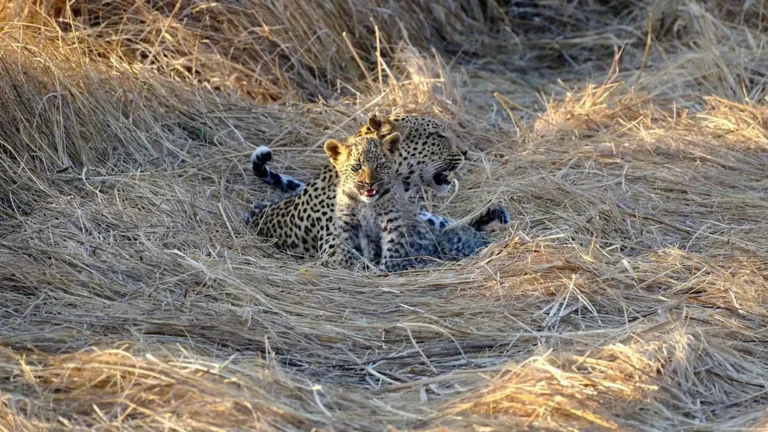
Female African leopards reach reproductive maturity around ages 2 to 3. After a gestation period of approximately 90 to 105 days, a female typically gives birth to two or three cubs, each weighing about two pounds at birth.
Mothers are highly protective and hide their cubs in dense vegetation, rock crevices, or hollow tree trunks to shield them from larger predators.

They frequently change den locations to minimize detection risks. Cubs begin venturing out at six to eight weeks, are fully weaned by three months, and remain with their mother for up to two years to learn essential survival skills.
Historically, African leopards ranged across sub-Saharan Africa, including West Africa, Central Africa, Southern Africa, and parts of North Africa.
However, habitat fragmentation and human encroachment have greatly reduced their historical range. They inhabit a variety of leopard habitats, including dense forests, riverine forests, grasslands, savannas, semi-deserts, and even urban areas adjacent to wildlands.
Botswana, with its extensive protected areas and riverine forests, is a key stronghold for African leopards, providing some of the best leopard habitats on the continent.
Botswana is renowned for its rich leopard population and diverse leopard habitats, including the Okavango Delta, Moremi Game Reserve, and Chobe National Park.
These areas offer a mosaic of ecosystems, ranging from dense riverine forests to open savannas, that support abundant prey. Botswana’s leopards are known for their strength and agility, often seen stalking prey or resting in trees.
The Moremi Game Reserve, in particular, is famous for leopard sightings, where visitors can observe these strong climbers hoisting their kills into trees to protect them from other predators.
African leopards have a broad diet that encompasses more than 90 prey species.
Their primary prey includes medium-sized ungulates such as impalas, gazelles, and small antelopes, but they also hunt small mammals, birds, reptiles, and occasionally insects.
As ambush predators, they rely on stalking prey silently through dense vegetation before pouncing.
After a successful kill, leopards often hoist their prey into trees to protect it from scavengers such as hyenas and lions, showcasing their remarkable strength and climbing ability.
Listed as Vulnerable on the IUCN Red List, African leopards face population declines due to habitat loss, fragmentation, and human-wildlife conflict. The expansion of agricultural land, urban development, and infrastructure projects has reduced suitable leopard habitats.
Leopards sometimes prey on livestock near human settlements, leading to retaliatory killings by farmers seeking to protect their animals. Illegal wildlife trade targeting leopard skins and body parts further threatens populations.
Although trophy hunting is regulated, its impact on leopard demographics, especially if females or multiple males are removed, remains a concern.
Conservation efforts in Botswana focus on managing protected areas, enforcing anti-poaching laws, and mitigating human-leopard conflicts through community-based strategies.
Conservation organizations like Wild Entrust, Panthera, World Wildlife Fund (WWF), and African Wildlife Foundation play a crucial role in these initiatives by supporting research, habitat preservation, and community engagement.
Establishing habitat corridors allows leopards to move between fragmented populations, supporting genetic diversity and population resilience.
Education and engagement with local communities help reduce retaliatory killings by promoting livestock protection measures and coexistence strategies.
Camera-trap surveys and telemetry tracking are widely used in Botswana to monitor leopard populations and behavior. Genetic studies help understand population structure and diversity.
Citizen science platforms encourage ethical reporting of leopard sightings, contributing valuable data for conservation planning.
Botswana offers some of the best opportunities to see African leopards in their natural habitat.
The Okavango Delta, Moremi Game Reserve, and Chobe National Park provide excellent leopard habitats and high chances of sightings. Early morning and late evening game drives are the best times to observe these predominantly nocturnal big cats.
Visitors benefit greatly from knowledgeable game safari guides who are skilled in tracking leopards and other wildlife, enhancing the chances of sightings and providing valuable insights into leopard behavior.
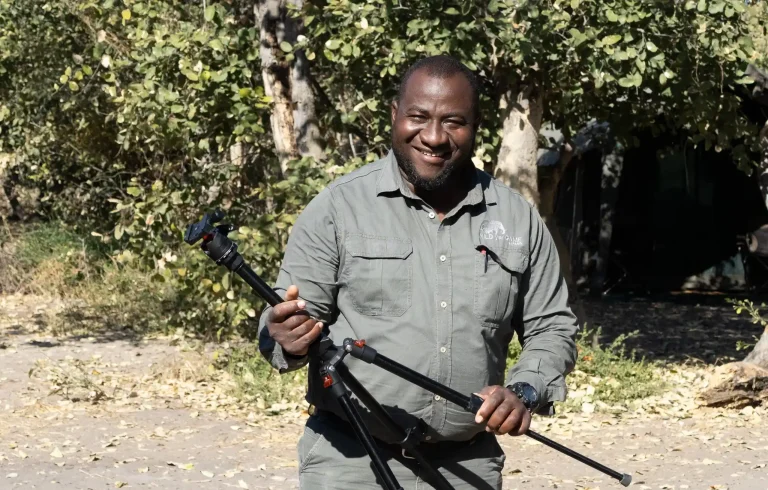
Our guides are also experienced photography experts who help wildlife enthusiasts capture stunning images of leopards in their natural environment.
Choosing ethical safari operators who prioritize wildlife welfare and conservation ensures responsible wildlife tourism.
Male leopards typically weigh between 90 and 200 lbs, while females weigh between 60 and 130 lbs. They exhibit sexual dimorphism, with males generally larger and heavier than females.
African leopards are widely distributed across sub-Saharan Africa, inhabiting diverse habitats such as dense forests, riverine forests, grasslands, savanna habitats, semi-deserts, and even areas near human settlements.
Their diet is highly adaptable and includes over 90 prey species. They primarily hunt medium-sized ungulates such as impalas and gazelles, but also consume small mammals, birds, reptiles, and occasionally insects.
African leopards are strong climbers and often hoist their prey into trees to protect it from scavengers like hyenas and lions. They can carry prey weighing up to two and a half times their own body weight into the branches.
The primary threats include habitat loss and fragmentation, human-wildlife conflict (such as retaliatory killings to protect livestock), illegal wildlife trade targeting skins and body parts, and poorly managed trophy hunting.
Yes, African leopards are predominantly solitary and nocturnal. They spend most of their time alone, except during mating or when females are raising their cubs.
The average lifespan of an African leopard in the wild is approximately 10 to 12 years.
The best places to see African leopards in Botswana include the Okavango Delta, Moremi Game Reserve, and Chobe National Park.
Conservation actions include habitat preservation, anti-poaching enforcement, community engagement to reduce human-wildlife conflict, the establishment of wildlife corridors, and regulated trophy-hunting policies.
Early-morning and late-evening game drives, guided by experienced safari guides who understand leopard behavior and habitats, offer the best opportunities for sightings.