Ready to Capture the Wild?
From expert-guided game drives to exclusive wilderness locations, every moment is designed for extraordinary wildlife encounters.

Discover fascinating facts about the Southern Ground Hornbill, one of Botswana’s most distinctive birds. Learn about its powerful call, diet, breeding behavior, lifespan, habitat and conservation.

Discover fascinating southern ground hornbill facts about one of Africa’s most iconic and impressive bird species. Known for their striking black plumage and vibrant facial colors, these remarkable birds captivate birdlife enthusiasts across South Africa and beyond.
In this article, we explore their unique physical characteristics, behaviors, cultural significance, and the conservation implications surrounding their survival. Whether you’re interested in african ornithology or simply curious about the diverse species diversity of animals in the aves order, this guide offers valuable insights into the southern ground hornbill’s world.
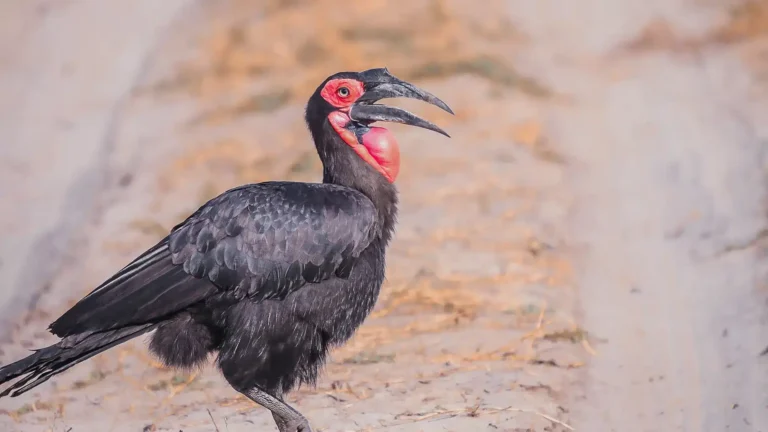
The southern ground hornbill, Bucorvus leadbeateri, is the largest species in the hornbill family worldwide, measuring between 90 and 129 centimeters in length, with a wingspan up to 1.8 meters. This impressive large bird is a dominant presence in its habitat and the largest in the hornbill order.
There are two species of ground hornbill, with the Abyssinian ground hornbill being the other member of the genus.
Male hornbills have vivid red patches of bare facial skin on their faces and throats, while females differ by having a striking violet-blue patch on their throats. This clear sexual dimorphism makes it easy for researchers and bird watchers to identify the sex of these birds in the wild. Juvenile birds have duller colors than adults.
Unlike many hornbills that primarily fly, southern ground hornbills spend most of their time on the ground, where their long eyelashes help protect their eyes while foraging.
They are carnivorous hunters that search for a variety of food on foot, feeding on insects, lizards, other small vertebrates, small mammals, and even snakes, using their strong beaks to catch and subdue prey.
These birds are obligate cooperative breeders, meaning breeding pairs live in small groups with other family members or helpers assisting the breeders to raise their young successfully.
This social structure helps increase the survival rate of their offspring in the wild. Within the group, the dominant male breeds with the female, and only the dominant male mates with the breeding female birds.
Southern ground hornbills have a low reproductive rate, with the breeding season typically leading to nesting only every three years. The female usually lays three eggs in a typical clutch. Usually, only one chick survives from the eggs due to siblicide, where the older chick outcompetes or harms its younger sibling.
They can live up to 70 years in captivity and around 30 to 40 years in the wild, and they also take many years to reach maturity, with birds reaching sexual maturity late. This delayed sexual maturity allows them to contribute to their social groups and territory defense for many years.
Their deep, booming calls can carry nearly two miles, serving as territorial announcements across the savannah grasslands, with the strongest calling activity often linked to the dry season. These vocalizations help defend a large home range and communicate between group members.
In traditional African cultures, southern ground hornbills are associated with rain, drought, death, and protection against evil spirits, with some beliefs holding that they can bring rain and that rituals involving them provide protection from harm.
These beliefs influence local conservation attitudes, sometimes protecting the birds while in other cases leading to persecution, including use in traditional medicine.
They require large territories, typically over 100 square kilometers per flock, and depend on nests in cavities in large trees. They occupy savannas, grasslands, and woodland habitats across southern Africa. They do not build nests from scratch but use natural hollows.
Classified as vulnerable by the International Union for Conservation of Nature (IUCN), southern ground hornbills face threats from habitat loss, hunting, and climate change.
Their survival often depends on protected areas, including national reserves such as Kruger National Park, where active conservation interventions help protect this endangered species and support its future.
Conservation action is especially important across northern South Africa, the Eastern Cape, and parts of the Democratic Republic of Congo in central Africa.
The southern ground hornbill is a remarkable bird species with unique physical traits, complex social behaviors, and significant cultural importance across Africa.
Despite their impressive size and longevity, these birds face numerous challenges, including habitat loss, low reproductive rates, and human-related threats. Conservation efforts focused on protecting their habitats and addressing cultural perceptions are vital to ensuring the survival of this iconic species.
By understanding southern ground hornbill facts and their role in the ecosystem, we can better appreciate their value and contribute to their preservation for future generations.
The mating season typically occurs in early summer, lasting from September to December. During this period, males inflate the bright red bare skin wattles on their throats to attract females.
Males attract females by inflating their red throat wattles and producing deep, booming calls that can carry over long distances. These vocalizations serve both to attract mates and to establish territory.
The southern ground hornbill (Bucorvus leadbeateri) belongs to the kingdom Animalia, phylum Chordata, class Aves, order Bucerotiformes, family Bucorvidae, and genus Bucorvus.
Southern ground hornbills are not significantly affected by international trade. Their primary threats come from habitat loss, local hunting for traditional medicine, and persecution within their native range.
Southern ground hornbills are found across southern and eastern Africa, ranging from Kenya in the north down to South Africa in the south. They inhabit savannas, grasslands, and woodlands where large trees are available for nesting.