
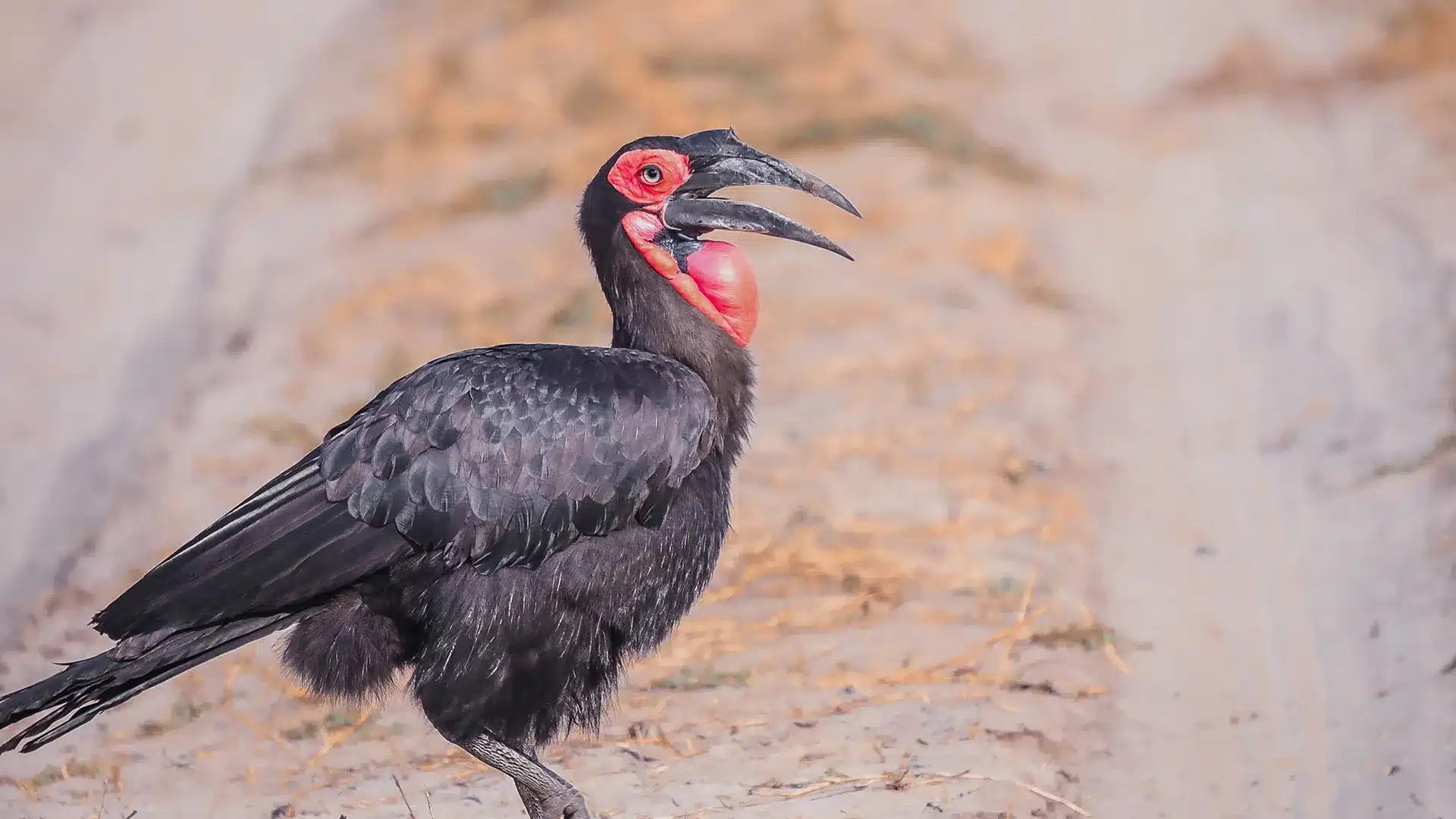

Southern ground hornbills (Bucorvus leadbeateri) are a remarkable keystone species native to eastern and southern Africa. Alongside the southern ground hornbill, the Abyssinian ground hornbill (Bucorvus abyssinicus) represents the other of the two species of ground hornbills found in Africa.
The Abyssinian ground hornbill is generally larger and distributed across northern sub-Saharan Africa, while the southern ground hornbill is found further south. Differences in size, facial coloration, and habitat preferences can distinguish between the two species. Southern ground hornbills are found in dry savannas, grasslands, and light woodlands across southern Kenya, Botswana, and Angola.
These large birds are easily recognized by their striking black plumage contrasted with vivid red or violet-blue patches of bare skin on their faces and throats. Males display pure red throats, while females have violet-blue coloring.
This article explores the fascinating characteristics, behavior, habitat, cultural significance, and conservation challenges of the southern ground hornbill.
Physical Characteristics of the Southern Ground Hornbill
The southern ground hornbill stands out as one of Africa’s most impressive avian species, easily recognized by its commanding presence and striking appearance.
Size and Wingspan
As the most prominent member of the hornbill family, this large bird measures between 90 and 129 centimeters in length, with a wingspan that can reach up to 1.8 meters.
Thats just about the size of a turkey, with a wingspan reaching approximately four feet, these birds are capable of flying speeds up to 18 miles per hour. While they can fly, southern ground hornbills spend most of their time on the ground, using flight mainly for roosting or territorial displays.
Weight Differences
Males are notably larger, weighing between 3.5 and 6.2 kilograms, while female birds are slightly smaller, typically ranging from 2.2 to 4.6 kilograms.
Plumage and Coloration
This size advantage, combined with their bold black plumage and white-tipped flight feathers, makes southern ground hornbills a distinctive sight as they stride across the savannah grasslands of eastern and southern Africa.
Bare Skin and Sexual Dimorphism
One of the most remarkable features of the southern ground hornbill is the vivid coloration of its bare skin patches.
Both sexes display bright red facial and throat skin, but females differ from males by exhibiting a unique violet-blue throat patch, a key characteristic for distinguishing the sexes in the wild.
Head and Casque
The head of the ground hornbill is topped with a prominent casque a horn-like structure that is more pronounced in male hornbills adding to their unmistakable silhouette. These visual cues not only play a role in communication and mating displays but also help researchers and bird enthusiasts identify individuals in the field.
Legs and Beak Adaptations
Adapted for a life spent mainly on the ground, southern ground hornbills possess long, sturdy legs and powerful feet, enabling them to cover large distances as they forage for food.
Their strong, curved beak is ideally suited for probing into the soil, turning over debris, and capturing a wide variety of prey, including insects, small animals, and small vertebrates such as lizards and snakes.
Vocalizations
As members of the hornbill family, they produce deep, rhythmic hooting calls that can carry nearly two miles across the savannah, serving as powerful territorial announcements.
Ecological Importance and Conservation Status
Ecologically, southern ground hornbills are apex predators in their habitats, playing a crucial role in maintaining the balance of savannah ecosystems by controlling populations of various small animals and small mammals.
African hornbills, including ground hornbills, are considered keystone species due to their importance in ecosystem functions such as seed dispersal and pest control. Still, they face significant threats from habitat loss, hunting, and trade. The Southern Ground Hornbill requires large territories for survival, typically over 100 square kilometers per flock.
Research and conservation efforts for southern ground hornbills have been widely discussed in the African journal literature, with studies by Coetzee et al. contributing valuable insights into their ecology, population dynamics, and the threats they face within Africa’s changing landscapes. The Southern Ground Hornbill is considered endangered in South Africa, Lesotho, Namibia, and Eswatini.
Southern ground hornbills are carnivorous, feeding on insects, reptiles, and small mammals. While they can fly, these birds prefer to walk or run as they patrol their territories in search of food, making them a keystone species in southern Africa’s ecosystems.
The southern ground hornbill’s physical adaptations are closely tied to its habitat preferences. These birds thrive in open savannah grasslands, light woodlands, and scrublands, where their size and coloration provide both camouflage and a commanding presence.
Southern ground hornbills require open grasslands with short grass for foraging and large, old trees for nesting. Their range extends across eastern and southern Africa, including central Africa, and they are most commonly found in protected areas such as Kruger National Park, national reserves, and regions like the Eastern Cape and Grahamstown.
Despite their widespread distribution, their populations are sparse, and habitat loss due to human activities and international trade remains a significant threat.
In addition to their ecological importance, southern ground hornbills hold cultural significance in traditional African cultures, where their striking appearance and behaviors are woven into local folklore and rituals.
Conservation organizations, including BirdLife International and the International Union for Conservation of Nature, recognize the species as threatened and are actively working to protect its habitat and ensure its survival.
Institutions like Tracy Aviary in Salt Lake City play a vital role in African ornithology, providing sanctuary and educational opportunities for the public to learn about these remarkable birds.
The southern ground hornbill’s unique physical characteristics not only make it an icon of Africa’s wild landscapes but also underscore the urgent need for conservation interventions to safeguard its future.
As a keystone species, its continued presence is essential to maintaining the health and balance of the savannah ecosystems it inhabits.
Habitat and Range of Southern Ground Hornbills
Southern ground hornbills inhabit diverse environments across eastern and southern Africa, including central Africa. Their preferred habitats include savannah grasslands, scrub, and light woodlands, where they can find ample food and suitable nesting sites.
Although widespread, their populations are sparse and primarily concentrated within protected areas such as national reserves and parks, including the famous Chobe National Park, Kruger National Park and Limpopo province.
They are also found in regions like the Grahamstown area and the Eastern Cape, where habitat conditions support their survival. The Grahamstown region is significant for hornbill conservation and research, with local efforts focused on protecting their habitats and studying their ecological roles.
These birds are well adapted to seasonal changes, thriving in both dry and wet seasons, and can survive in areas with limited water resources.
Their habitat typically features large, old trees, which are essential because southern ground hornbills build nests in high tree cavities or rock holes, making these nesting sites critical for raising their young.
As a keystone species threatened by habitat loss, hunting, and climate change, southern ground hornbills require targeted conservation efforts to ensure their continued survival and the health of their ecosystems.
Best Places to Photograph the Southern Ground Hornbill in Botswana
Botswana offers excellent opportunities to photograph the southern ground hornbill in its natural habitat. The country’s vast savannah grasslands, woodlands, and protected areas provide ideal environments for these striking birds. Some of the best locations include:
Chobe National Park
Known for its rich biodiversity, Chobe’s open savannahs and riverine woodlands are prime habitats for southern ground hornbills. Photographers can often spot these large birds walking on the ground in small groups, especially during the dry season when vegetation is sparse.
Okavango Delta
This unique wetland ecosystem supports diverse wildlife, including southern ground hornbills. The delta’s mosaic of grasslands and woodlands offers excellent vantage points for bird photography, with opportunities to capture the hornbills’ vivid red patches and distinctive calls.
Moremi Game Reserve
Located within the Okavango Delta, Moremi’s varied habitats provide an excellent setting for observing and photographing ground hornbills. Early morning and late afternoon are ideal times to catch their booming calls and active foraging behavior.
When planning a photography trip, the dry season (May to October) is recommended, as animals, including southern ground hornbills, are more easily spotted due to reduced foliage and their tendency to congregate near water sources.
Using a telephoto lens and maintaining a respectful distance will help capture detailed images of these magnificent birds without disturbing their natural behavior.
Cultural Significance of the Southern Ground Hornbill
The southern ground hornbill holds profound cultural importance across many traditional African cultures. Often regarded as a symbol intertwined with various beliefs and rituals, this bird is both revered and feared.
In several communities, the southern ground hornbill is associated with rain, drought, and fortune, believed to have the power to influence weather patterns.
For example, some cultures interpret the bird’s early morning calls as a sign of impending rain. In contrast, others see the hornbill as a protector against drought and lightning through specific traditional rituals.
Conversely, in parts of South Africa, Zimbabwe, and Malawi, the bird is often linked to death, misfortune, and evil spirits.
The Ndebele people, for instance, consider killing a southern ground hornbill taboo, believing it will bring death upon the perpetrator. Similarly, some groups view the bird as a messenger of death or a bringer of bad luck, leading to avoidance or even persecution.
The southern ground hornbill is also used in traditional medicines and cultural ceremonies, where parts of the bird may be harvested for their perceived spiritual or protective properties.
These practices, while culturally significant, sometimes pose challenges to conservation efforts. Nonetheless, ethnobotany research has explored plant-based alternatives to reduce reliance on birds in traditional medicine.
Overall, the cultural significance of the southern ground hornbill is complex and varies among different African communities.
These beliefs influence both the protection and threats faced by the species, underscoring the importance of integrating cultural understanding into conservation interventions to ensure the bird’s survival while respecting local traditions.
Behavior and Reproduction Patterns
Southern ground hornbills exhibit fascinating social and reproductive behaviors, including obligate cooperative breeding. Breeding pairs rely on assistance from family members or helpers to raise their young successfully.
These birds reach sexual maturity relatively late, around six to seven years of age, but typically begin breeding at about ten years old. Nesting occurs in deep hollows of large trees, where females lay one to three eggs.
However, due to siblicide a behavior where only one chick survives usually only one chick fledges. The female southern ground hornbill incubates the eggs and is fed by the dominant male and other helpers.
The incubation period lasts about 40 days, during which the female incubates the eggs while the male and helpers provide food and protection.
The slow reproductive rate, with successful breeding approximately every three years, underscores the importance of conservation efforts.
Southern ground hornbills are also known for their unique mating rituals, which include loud booming calls and displays of their vivid bare skin patches, which help attract mates.
Threats to Southern Ground Hornbills
Despite their ecological importance, southern ground hornbills face numerous threats that jeopardize their survival.
Habitat loss due to pollution, logging, agricultural expansion, and climate change leads to the destruction of nesting sites and a reduction of food availability.
These pressures make conservation interventions essential. Additionally, the birds are hunted for use in rituals and traditional medicine in some traditional African cultures; in certain beliefs, southern ground hornbills are used in rituals to ward off evil spirits or to provide protection against natural disasters such as lightning and drought.
Others poison them because of their behavior of attacking reflections in windows. Accidental deaths caused by landmines and human persecution further contribute to population declines and local extinctions.
The Southern Ground Hornbill faces threats due to accidents caused by power lines, leading to electrocution and poisoning. Climate change has also been observed to disrupt their calling patterns, which in some cultures are traditionally used to predict weather changes, impacting both cultural practices and the birds’ breeding success.
Furthermore, international trade pressures can lead to the removal of individuals from the wild, exacerbating conservation challenges.
Conservation Efforts for Southern Ground Hornbills
Conservation initiatives for southern ground hornbills are multifaceted and critical for the species’ survival. Captive breeding and reintroduction programs, such as those led by the Mabula Ground-Hornbill Project in South Africa, have shown promise in bolstering wild populations.
Research efforts by conservationists, including National Geographic grantee Yvette Ehlers Smith, focus on developing better protection strategies. Public awareness campaigns aim to change negative perceptions and reduce human-wildlife conflicts, such as preventing birds from crashing into windows by covering reflective surfaces.
Conservation implications emphasize protecting nest sites, active management in protected areas, and addressing the species’ low reproductive rates. Organizations such as BirdLife International and the International Union for Conservation of Nature (IUCN) provide essential frameworks and data for assessing conservation status and guiding effective management.
Ethnobotanical research and studies from regions including the Eastern Cape and Grahamstown, and from institutions such as the Tracy Aviary in Salt Lake City, provide valuable insights into the species’ ecology and the challenges posed by climate change, informing adaptive conservation strategies.
Southern ground hornbills remain an iconic symbol of African wildlife, embodying the intricate connections between natural resources, ecosystems, and cultural heritage.
Their protection is vital not only for biodiversity but also for preserving the rich traditions and ecological balance of the regions they inhabit. Continued conservation interventions, research, and community engagement are essential to ensure these magnificent birds thrive for generations to come.
Frequently Asked Questions (FAQ)
What is a southern ground hornbill?
The southern ground hornbill (Bucorvus leadbeateri) is the largest species of hornbill found in eastern and southern Africa. It is a large bird with striking black plumage and vivid red or violet-blue bare skin patches on the face and throat.
Where can southern ground hornbills be found?
They inhabit dry savannas, grasslands, and light woodlands across eastern and southern Africa, ranging from Kenya and Burundi down through Tanzania, Angola, Botswana, Zimbabwe, and into South Africa, Namibia, Eswatini, and Lesotho. They are mostly prevalent in protected areas such as Kruger National Park and Limpopo province, as well as regions such as the Eastern Cape and Grahamstown.
What do southern ground hornbills eat?
Southern ground hornbills are carnivorous, feeding primarily on insects, reptiles, small mammals, and small vertebrates such as lizards and snakes. They forage mainly on the ground.
How do southern ground hornbills reproduce?
They are obligate cooperative breeders, in which breeding pairs receive help from family members in raising their young. Females lay one to three eggs in tree cavities, but usually only one chick survives due to siblicide.
Why are southern ground hornbills considered vulnerable?
Habitat loss, hunting, low reproductive rates, and environmental changes threaten their populations. They require large territories and old trees for nesting, which are increasingly scarce due to human activities.
What cultural significance do southern ground hornbills have?
In traditional African cultures, these birds are associated with rain, drought, death, and protection against evil spirits. Cultural beliefs vary and can influence conservation positively or negatively.
What conservation efforts exist for southern ground hornbills?
Conservation interventions include habitat protection, captive breeding and reintroduction programs, public awareness campaigns, and research to understand their ecology and threats better.
Can southern ground hornbills fly?
Yes, they can fly, but they spend most of their time on the ground. Flight is primarily used for roosting and territorial displays.
How long do southern ground hornbills live?
They can live up to 70 years in captivity and around 30 to 40 years in the wild.
How can I help protect southern ground hornbills?
Supporting conservation organizations, promoting habitat preservation, and raising awareness about the species and its ecological importance can contribute to their protection.